HUNTSVILLE, Alabama — Alabama’s farmland is about to become fertile ground for a new kind of industry.
The HudsonAlpha Institute for Biotechnology, leading a coalition of universities, manufacturers and agricultural partners, has been awarded an initial $15 million — with the potential for up to $160 million over 10 years — through the U.S. National Science Foundation’s Regional Innovation Engines (NSF Engines) program.
The initiative, known as the BRIDGES Engine, will transform underutilized farmland across Alabama and Tennessee into a launchpad for biobased manufacturing, new jobs and long-term rural prosperity.
The award places Alabama at the center of a national push to convert homegrown science into homegrown economic growth. Out of 300 applicants nationwide, BRIDGES was selected as one of just 12 teams across 20 states to receive funding — a distinction that reflects the strength of Alabama’s research talent and its growing reputation as a hub for biotechnology and advanced manufacturing.
“BRIDGES is exactly the kind of investment that reflects what makes Alabama a national leader in innovation — a skilled workforce, world-class research institutions and a business climate that turns discovery into opportunity,” said Ellen McNair, Secretary of the Alabama Department of Commerce. “This project will put rural Alabama communities at the forefront of the bioeconomy, and we’re proud to see our state’s talent and land power the next generation of American manufacturing.”
HudsonAlpha President Neil Lamb said the institute is honored that the National Science Foundation has chosen to support the BRIDGES Engine as a model for regional innovation and economic transformation.
“Together with our partners across Alabama, Tennessee and beyond, we’re proving that investment in use-inspired science and technology can drive both prosperity and purpose, shaping a stronger, more resilient future for our region and our nation,” Lamb said.
Turning Farmland into a manufacturing supply chain
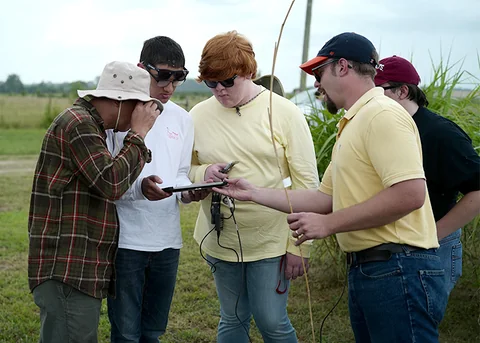
At the heart of BRIDGES is a simple but powerful idea: Put Alabama’s land and its people to work growing the raw materials of tomorrow’s industries. The project will cultivate specially developed perennial grasses — including switchgrass and Miscanthus — that improve soil health while serving as feedstocks for automotive, construction and packaging products. In partnership with Auburn University, the University of Tennessee, Volkswagen Group of America and AGgrow Tech LLC, BRIDGES will build the supply chains needed to turn those crops into market-ready materials, strengthening domestic manufacturing along the way.
HudsonAlpha faculty investigators Jeremy Schmutz and Kankshita Swaminathan, PhD, will lead the genomic research behind the effort, applying the institute’s decades of expertise in genetics to optimize these crops for yield, resilience and performance — a clear example of Alabama’s scientific workforce translating world-class research into real-world results for farmers and manufacturers alike.
“This award shows that NSF recognizes the strength of the plans our team has developed that will drive lasting economic development across rural Alabama and Tennessee,” said Sam Jackson, CEO of the BRIDGES Engine. “I am excited to begin the real work with our 85 partners to create new markets for farmers, create new manufacturing jobs, and provide skills training to workers in rural communities across the region.”
An investment in Alabama’s workforce
The scale of BRIDGES’ ambition is matched by its projected impact. Over the life of the award, the initiative aims to:
- Convert 50,000 acres of underused farmland into high-yield perennial crop production, generating $30 million in annual farm income;
- Attract more than $2 billion in private capital investment to rural Alabama and Tennessee;
- Create over 4,000 new manufacturing and supply-chain jobs, adding $280 million in annual wages;
- Train more than 10,000 people for careers in agriculture, technology and manufacturing;
- Improve manufacturing efficiency by 25% in automotive and packaging and 10% in construction.
That workforce investment is central to why state leaders see BRIDGES as more than a research grant — it’s a talent pipeline.
A model for the nation
BRIDGES joins a national network of NSF Engines designed to build regional innovation ecosystems that translate research into economic growth. Each Engine can receive up to $160 million over a decade to build sustainable, inclusive networks that strengthen U.S. competitiveness.
“These new NSF Engines will be transformational for America’s innovation infrastructure, helping ensure national security and U.S. competitiveness in technologies that have the capacity to shape life for decades to come,” said Erwin Gianchandani, NSF assistant director for Technology, Innovation and Partnerships.
With 42 industry collaborators, 18 academic institutions, 10 commercialization partners and 15 stakeholder organizations already engaged, BRIDGES is built as an ecosystem, not a single project — one where farmers, scientists, manufacturers and policymakers work toward a shared goal.
“This initiative depends on collaboration,” Jackson added. “It’s a bridge between science and industry, education and opportunity, research and real-world impact.”
For Alabama, the message is clear: the state’s fields, labs and factories are converging around a single opportunity — and its people are the ones building it. As BRIDGES moves from vision to execution, rural Alabama is poised to become a proving ground for what happens when scientific expertise, local talent, and industry ambition grow in the same soil.