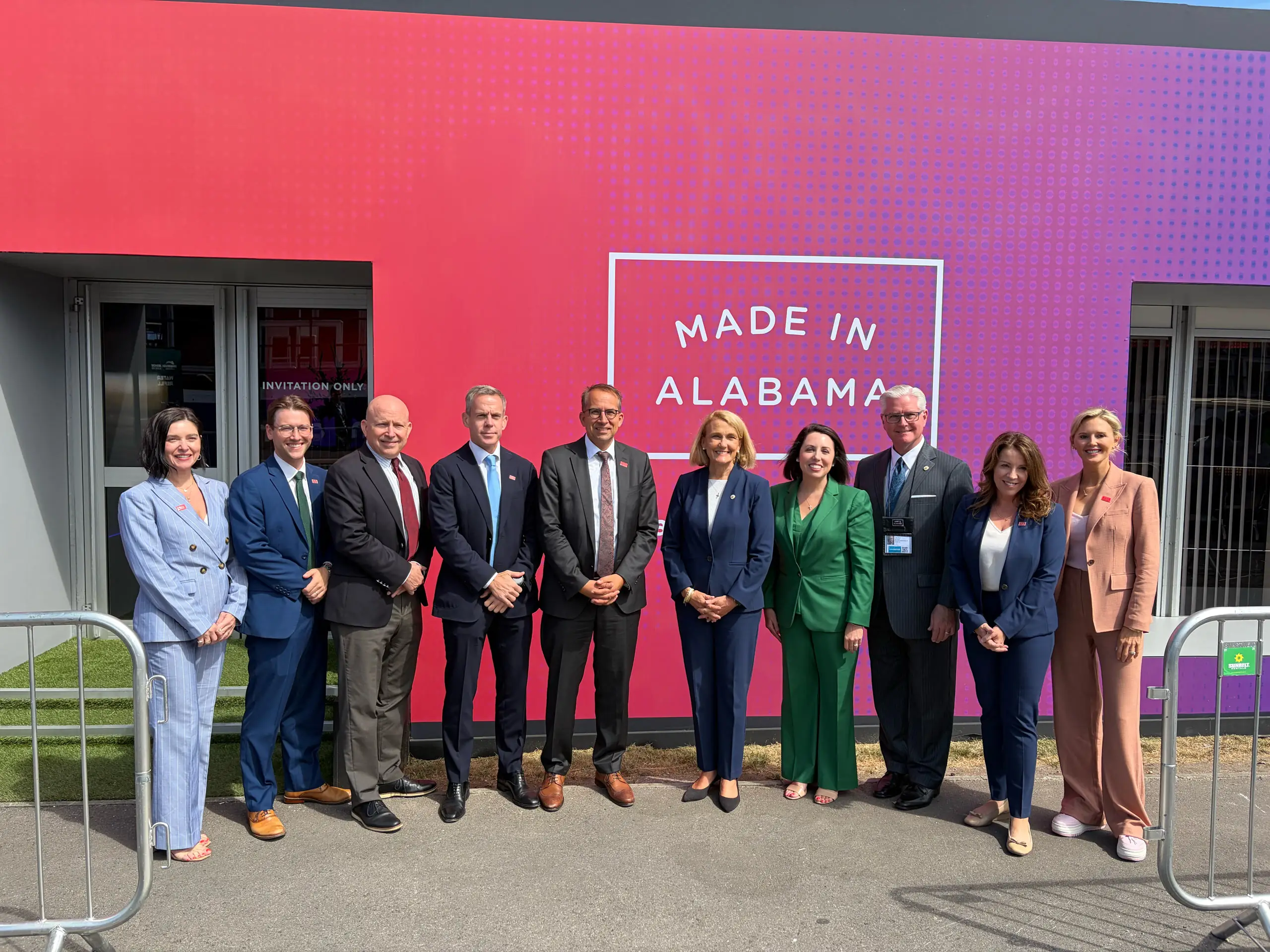
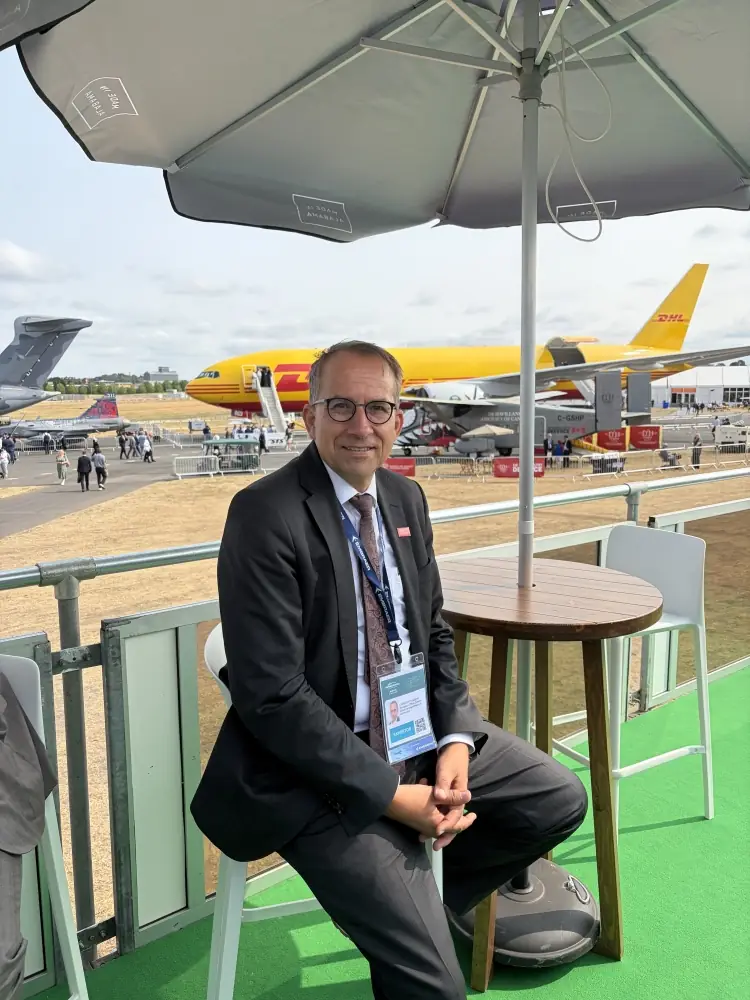
LONDON, England – The Alabama Department of Commerce’s industry recruiting team at the Farnborough International Airshow this week includes its point men in Europe and South Korea.
Christoph Dörr has run Commerce’s European office from Germany since 2019. Last year, Commerce announced the creation of business development offices in Seoul and Tokyo to further the state’s ability to attract foreign direct investments. Sean Blakeley leads the Korea office. The Tokyo office will open later this year.
Dörr and Blakeley work across all industries, including aerospace and aviation, promoting Alabama as a premier spot for U.S. operations. As defense and aerospace spending around the world increases and companies respond to capability and production demands, the state is increasing its recruitment efforts in those sectors.
“Alabama has prioritized increasing our foreign direct investments across multiple sectors,” said Commerce Secretary Ellen McNair. “But now is a critical time in defense and aerospace growth for the state to expand our reach in these advanced manufacturing fields.”
Since 2015, aerospace, defense and aviation companies have announced $4.3 billion in new investments in Alabama, resulting in more than 15,000 new jobs. In 2025 alone, Alabama exported $1.7 billion in aerospace equipment, an increase of more than 12% from 2024.
The Farnborough airshow is a premier week-long showcase of aviation and defense companies’ best and newest technologies and manufacturing advancements. Alabama’s delegation at the show is co-led by McNair and seven of her top team members.
“We’re in Farnborough to show companies, whether they’re in the U.S., Europe or Asia, that Alabama knows the formula for success in these sectors,” McNair said. “That includes our pro-growth policies, available space and infrastructure and skilled workforce.”
Japan and South Korea last year signed memorandums of understanding to spend $550 billion and $350 billion, respectively, on U.S. investments to avoid higher U.S. tariffs on goods. Both MOUs include commitments for expanding shipbuilding and other defense and national security spending.
“These countries have made tremendous commitments to the U.S., and we now have incredible opportunities to partner with foreign companies and bring more quality jobs to Alabamians,” McNair said.
Along with Germany, Japan and South Korea are Alabama’s top three international investment partners.
Blakeley said Korean companies have the high-tech manufacturing capability and capacity to respond to increased defense production for the U.S. and other NATO countries.
“Koreans are very keen to meet that demand, particularly in the United States, and that’s why you’re seeing the presence of Korean original equipment manufacturers and their supply chains rise at these international shows.”
Besides business-friendly policies, Blakeley said the state’s assets for attracting more Korean companies include the existing community in Alabama first built around the automotive industry. There is also a good standard of living and relatively low wage burden for employers.
Dörr can point to Airbus, headquartered in France, as a significant success story for European companies moving into the U.S. Since opening in Mobile in 2015, Airbus has more than doubled its production.
“It’s always helpful for companies in Europe to see what’s happening in Alabama and what it can mean for them,” Dörr said.
He stresses that expansion into U.S. markets does not mean ending their current operations.
“If a company goes to Alabama, it’s not just to start a production there and close it in Europe,” Dörr said. “Normally, it’s very helpful to start in a growing market because Europe is not growing as fast as the U.S.”
The U.S. economy has outpaced that of the European Union for nearly 20 years.
“… Alabama and the Southeast is a fast-growing market and that helps European companies who put a foot here,” Dörr said.
In 2025, European companies announced projects in Alabama totaling about $2.6 billion in new investments and more than 800 jobs, according to Commerce data.
Dörr also sells Alabama’s business-friendly policies and how quickly a company can set up here. Workforce recruitment and training are another huge plus.
Before opening Commerce’s European business development office in 2019, Dörr ran a German industrial company in Alabama for seven years. He points to his own experiences, including Alabama Industrial Development Training’s workforce recruitment, when talking to prospective companies.
“That was one of my biggest concerns,” he said. “We could find customers, we could get a building and buy machines, but what happens if no one is working?
“And that’s what AIDT did for us. Not just training people at no cost, but finding the right people.”