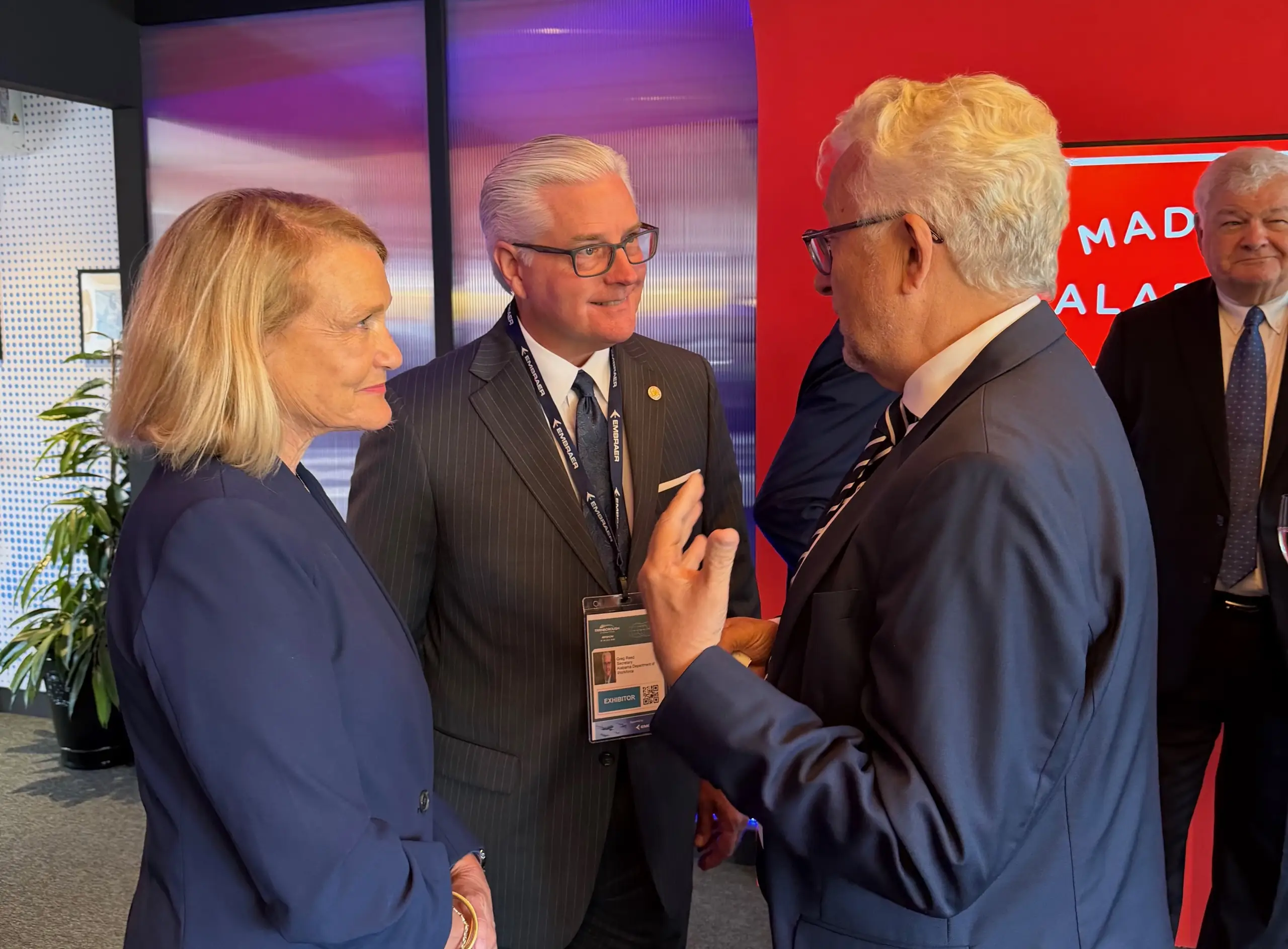
LONDON, England – Before he became the state’s first secretary of workforce 17 months ago and before he was a state senator for 14 years, Greg Reed had a career in sales.
His pitches are now very different than when he was promoting medical products to physicians and hospitals, but in a way he’s still in sales – selling prospective companies on Alabama and its workforce.
This week, Reed is at the Farnborough International Airshow as part of the state’s job-recruiting delegation led by Commerce Secretary Ellen McNair and Liz Filmore, Governor Kay Ivey’s chief of staff.
“We want the world to know what Alabama brings to the table, including the work of our people and everything associated with our workforce growth,” Reed said.
In 2024, the Legislature and Ivey reorganized and rebranded the Alabama Department of Labor as the Alabama Department of Workforce to focus on building talent pools of workforce and career-ready Alabamians.
“We’ve consolidated into one house strong collaborations with our education partners and industry partners, where government, business, industry and education are linked and all rowing in the same direction,” Reed said. “And that’s strong, and those levels of collaboration are differentiators when it comes to how well you’re going to be able to do as a business model when you decide to locate in Alabama.”
Reed said prospective industry officials repeatedly tell state leaders that finding qualified and skilled workers is their biggest challenge. Addressing that gives Alabama a recruitment edge others don’t have.
“We want many across the globe to recognize that that consolidation is a positive thing for us in being able to offer support for workforce growth, which is going to be beneficial to them,” Reed said. “They’re going to have a one-stop-shop, a repository of all things workforce related.”
Farnborough is one of the largest gatherings of aerospace, aviation and defense industries and previous shows have netted the state major economic development announcements.
Others in Alabama’s delegation this year include higher education leaders, local community and economic development officials, state lawmakers and U.S. Sens. Katie Britt and Tommy Tuberville.
Another point of persuasion for the state is its nationally recognized Alabama Industrial Development Training, Commerce’s workforce recruitment and training arm. As part of the state’s incentive package for new and expanding industry, AIDT has worked with more than 20 aviation and aerospace companies to train more than 6,000 Alabamians for careers at companies including Airbus and Lockheed Martin.
“As aerospace technologies continue to evolve, workforce development must evolve as well,” said AIDT Executive Director Kevin Taylor. “Long-term aerospace investment depends on a reliable talent pipeline, and Alabama’s commitment to workforce training and strong partnerships among industry, education and workforce organizations positions the state to support the next generation of aerospace manufacturing, aviation, defense and space-related industries while creating opportunities for future generations.”
The agency can support a company hiring 10 or more full-time, direct employees.
For very large employers planning to hire about 500 or more people, part of the state’s incentive package may include the creation of on-site training centers for their new workforce. Services range from screenings to pre-employment and job-specific training. Many of the state’s largest manufacturers have centers that continually supply them with the workforce they need.
Ashley Phillips, AIDT’s assistant director in south Alabama, was the agency’s project manager on Airbus when it selected Mobile for its first U.S. manufacturing facility that now employs more than 2,000 people. Phillips worked with Airbus’ human resources department to build that early workforce.
“It’s really about what the company is needing – if we have the means to do it, we’ll do it,” Phillips said. “We’re definitely partners.”
It was the first time AIDT recruited for salaried positions for a company.
Davida Williams is now project manager for Airbus, which has undergone multiple expansions in the more than a decade since it opened in Alabama. When recruiting new employees, Williams looks for those with transferable skills that could benefit Airbus.
“Maybe this person worked in shipbuilding or automotive maintenance,” she said. “What in that skill set can transfer to aviation?”
There are also opportunities for people without related experience to enter AIDT programs. Phillips’ office is in AIDT’s Maritime Training Center in Mobile where people with no experience can learn skills like welding and fitting in 14-week courses at no cost.
Multiple companies hire from the center and almost all students who want a job have one by the time their course is complete.
AIDT also offers companies, at no cost, leadership courses and safety training to help them comply with federal Occupational Safety and Health Administration rules.
For Reed, another selling point in Farnborough is the collaboration across the state’s education institutions, including two- and four-year colleges and high school career tech programming. In the two most recent state education budgets, $250 million has been dedicated to expanding career tech programs.
Separately, the department’s Office of Apprenticeship has programs with more than 500 companies, training people in more than 150 occupations.
“This is something we can tell companies across the globe we have – not something we’re planning to start,” Reed said. “This is available today.”